Intro to Passwords
Passwords are the first line of defense in protecting your online accounts and personal information. They act as digital keys, granting access to your emails, bank accounts, social media, and other private data. Despite their importance, many people still use weak or repeated passwords, making it easy for cybercriminals to break in. This is understandable, since nobody can remember strong, unique passwords for every account they make online. Thankfully, password managers can handle both. Learning what makes a strong password and how to manage them effectively is one of the most important steps toward staying safe online.
A strong password should be long, unique, and difficult to guess. It should avoid common words, personal details, or predictable patterns like “123456” or “password.” Instead, effective passwords mix upper and lowercase letters, numbers, and special characters. Using different passwords for each account helps ensure that if one account is compromised, the others remain secure.
As previously mentioned, remembering dozens of complex passwords can be a challenge - that’s where password managers come in. These tools safely store (and can generate, if so desired) passwords for all your accounts, so you only need to remember one master password. Combined with features like multi-factor authentication (MFA), which adds an extra layer of verification, you can significantly strengthen your online security and reduce the risk of being hacked.
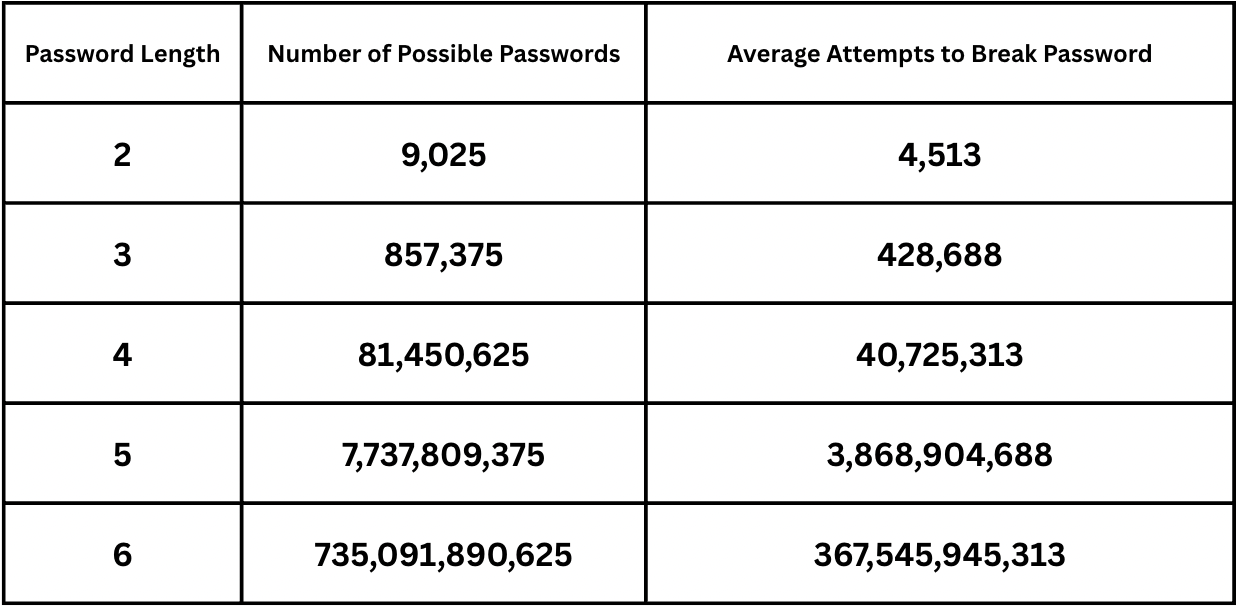

The length of a password is the biggest determining factor in its security. As passwords get longer, the number of possible combinations increases exponentially.¹ For example, with 95 possible keyboard characters, a two-character password has just over 9,000 possible combinations, while a six-character password has more than 735 billion. Because hackers would need to try, on average, half of all possibilities to guess correctly, even adding a single extra character makes a password vastly harder to break.
¹ “Analysing The Impact Of Password Length And Complexity On The Effectiveness Of Brute Force Attacks”, International Journal of Network Security & Its Applications, March 2025